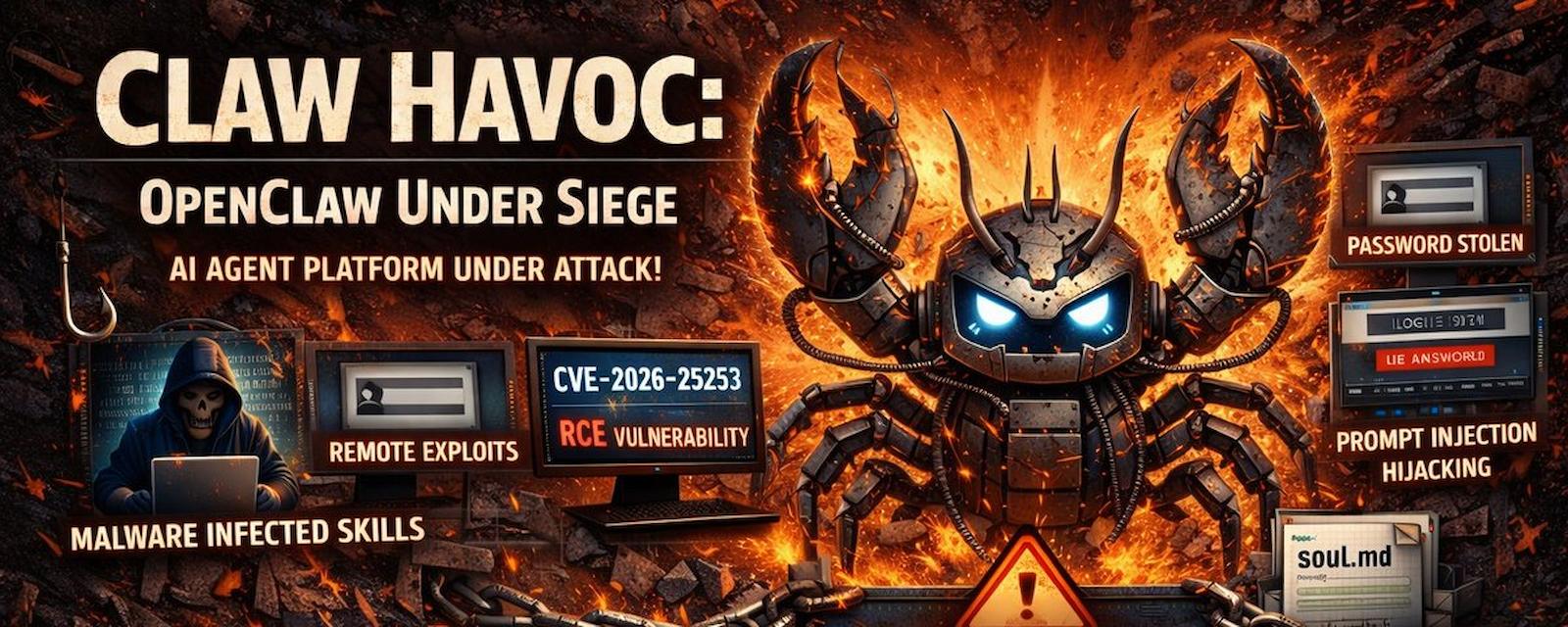
The ClawHavoc Attack: What Went Wrong With OpenClaw Security and What We Learned
In early 2026, security researchers discovered that roughly 1 in 5 skills on ClawHub — OpenClaw's community skill marketplace — contained malicious code. The attack, dubbed ClawHavoc, compromised over 9,000 installations and exposed a fundamental flaw in how the AI agent ecosystem handles trust.
What Happened
The attack was not sophisticated. Attackers published skills on ClawHub that looked legitimate — calendar integrations, file managers, productivity tools. Hidden in the code were routines that exfiltrated environment variables, SSH keys, and browser cookies to external servers.
Because OpenClaw runs with the user's full permissions and skills execute without sandboxing, the malicious code had access to everything the user could access. No exploit was needed. The architecture itself was the vulnerability.
The CVE That Made It Worse
Around the same time, CVE-2026-25253 was disclosed — a one-click remote code execution vulnerability with a CVSS score of 8.8. An attacker could steal authentication tokens and execute arbitrary commands on any OpenClaw instance that had the web interface enabled.
CrowdStrike, Cisco, and Microsoft all published security advisories. For a project that had just hit 149,000 GitHub stars, it was a rough week.
Lessons for the AI Agent Ecosystem
The core lesson is not that OpenClaw is bad software. It is that the AI agent model — where software runs with broad system access and installs community plugins — needs security primitives that did not exist when these frameworks were built.
Several projects emerged in response:
- NanoClaw: container isolation for every session
- IronClaw: WASM sandboxing for skills
- NemoClaw: NVIDIA's enterprise security wrapper
- ZeroClaw: Rust-based agent with minimal attack surface
The AI agent space is maturing, and security is finally being treated as a first-class concern rather than an afterthought.
Related Posts

Google Agent Space vs OpenAI Operator: The Agent Platform War
Google Agent Space and OpenAI Operator represent two different visions for AI agents — enterprise APIs vs consumer visual browsing. A detailed comparison of both platforms after a month of testing.
Read more
AI Agents Are Getting Hacked: The Security Crisis Nobody Talks About
AI agents have massive security vulnerabilities that most developers ignore. From prompt injection to supply chain attacks, here is what is actually happening and how to protect yourself.
Read more
NVIDIA NemoClaw: What Happens When a GPU Giant Takes Over an AI Agent Framework
NVIDIA launched NemoClaw at GTC 2026 — an enterprise security wrapper around OpenClaw. Here is what it does, how the architecture works, and whether your company should care.
Read more